I told my friend Jonathan that he’s like a goat. He climbs anywhere and everywhere that he can find one toehold. Me…not so much. When he invited me to come visit this past summer in Puerto Rico, I don’t know if he knew he was inviting such a scaredy cat. I’m petrified of heights, hate roller coasters and thrill rides, and prefer in general, to keep my feet planted firmly on the ground, at sea level, where I don’t get dizzy and there’s zero risk I can fall off a cliff.
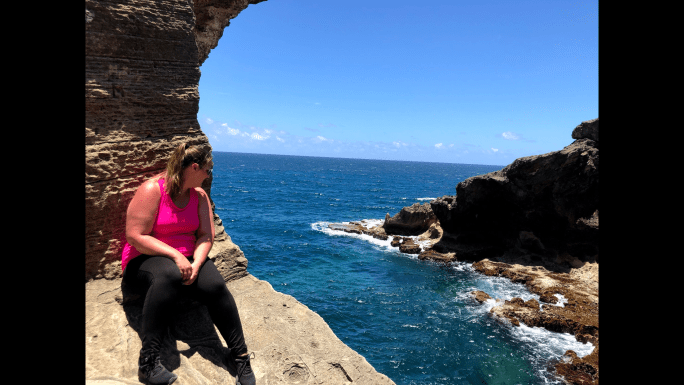
Yet, I quickly found that in Puerto Rico, there’s plenty of thrills to be found, and that boriquas love nothing more than to laugh in the face of danger. We hiked in many places around the island, along one beautiful cliff after another, through caves, with both of my friends Jonathan and Miguel blatantly ignoring every “Danger Zone” sign posted. At one point, I volunteered to hold the bags and stand by while they scaled down a cliff that led into secluded beach, revealed only at low tide. A sign not even 10 feet away from me said, “No Climbing” while 20 feet before that, there was another sign with a metal bar that said “Do not pass.” I thought the signs seemed pretty reasonable in their warnings and was worried about breaking the rules, and I didn’t know how I could possibly get down there safely with no real steps or clear path down, let alone climb my way back up. And so I watched in awe as Jonathan and Miguel brazenly pushed the boundaries of not only safety but also what I thought was even feasible. When Miguel’s head popped back up over the overhang into my view, he immediately said to me, “Jill, now you know the Puerto Rican people’s true nature- we are oppositional in our hearts.” And I laughed because I knew it was 100% truth!
Last school year, I had struggled in having made the move to a bilingual school, filled mostly with students who had fled the island after Hurricane Maria hit and devastated their homes. These students were not typical English Language Learners that I had become accustomed to…for one, they weren’t refugees or immigrants, but American citizens. Second, they hadn’t moved to the mainland US with visions of the American Dream and great optimism for a new life, as other families I had worked with. They just wanted to go back to Puerto Rico, but couldn’t because they had nothing left to go back to. They were not docile, but rambunctious, they were not timid but loud, and they were not compliant and excited about learning English, but argumentative, stubborn, and oppositional. At first, I felt discouraged – I was one of only a couple of teachers in the school that didn’t speak Spanish, and felt like an outsider. I was stuck on how to motivate students who saw learning English as not only unnecessary, but completely irrelevant to their lives. I set to work getting to know my students- their interests, their families, everything I could. And I ran my classroom the way I usually do- fair but firm. And little by little, I realized my students were working for me, were willing to try, because of the relationship I built with them. And, as other teachers, who were fluent in Spanish, had more and more problems with students over the course of the year, I had less and less.
I had quickly observed that teachers who attempted to use force and fear to motivate the students into anything were quickly met with the kids’ iron will and a refusal to change. Honey over vinegar, I guess. And over time, I came to really respect my students’ strength and sense of identity. They were growing into young adults, and they had a strong Puerto Rican pride and held their homeland close to their hearts, despite having to leave.
I found that same sense of pride while traveling in PR, with gift shops and PR merchandise sold for boriquas, not just tourists. By the end of the school year, of course, I had done some reading and research and I had learned of the atrocities committed against the Puerto Rican people by the United States throughout history – since we had swooped in to claim the strategically located island for our own as soon as Spain granted their former colony independence, we had bombed them, performed sick medical experiments on unknowing victims, and gagged their culture and language in colonial power moves. Now, most Puerto Rican people still yearn for independence as their own nation, and that sense of defiance and opposition is a source of pride for them.
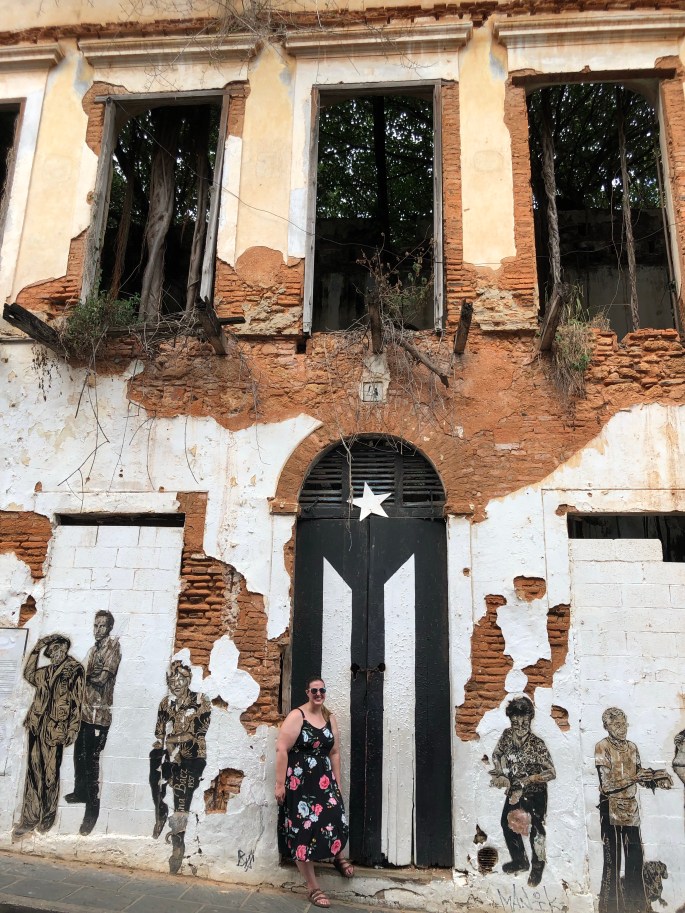
Traveling there certainly felt like I had entered another country. Spray painted statements made it clear that as one of the last colonies left in the world, the people desire freedom. We visited a bookstore and the shelves were full of books from Puerto Rican thinkers and revolutionaries who analyzed the island’s past attempts at overthrowing the United States’ rule, as well as analyses of the economic downturn, and the neoliberal post-disaster privatization of the island’s services that were failing the island’s people, while lining the pockets of US lobbyists. The negative attitude towards learning English and moving to New York now made a lot more sense to me. It was ingrained into their culture, their upbringing, until the kids realized I wasn’t just another gringa who didn’t really give a crap about them as individuals or people. I really did care, and I don’t know if I ever would have truly understood where my students were coming from, culturally, emotionally, and ideologically, if I hadn’t been able to visit the island myself.
This sense of frustration and rebellion came to a head the day after I returned from my vacation, when protests erupted over leaked texts from the governor of Puerto Rico. A long list of politicians and leadership screwing over the people for their own gain came before him, and it wasn’t something that the Puerto Rican people were willing to stand, especially in the wake of so much struggle and loss from the hurricane. I texted Jonathan as soon as I heard the news, and he told me he was out protesting, that people had flooded the streets and were demanding that the governor resign. And it worked!
I felt a sense of pride in those peaceful demonstrations and their success, even if I wasn’t there for them and I’m not Puerto Rican. I feel the same sense of frustration at injustice and I have a stubborn side that won’t move an inch if I believe I’m in the right. Looking back on my trip to Puerto Rico, I’m so appreciative of what I learned about my students, who I admire and respect, as well as the boriquen people as a whole for their strength and resistance to maintain and promote their cultural and political independence. For someone like me, who is generally a rule follower, pushing boundaries can feel dangerous, but it’s clear that at times it’s necessary to enter the danger zone to do what’s right and to maintain your sense of self in the face of any oppression, whether it be big or small.
 Jill Came Tumbling After